
- Botanical name: Lophophora williamsii
Common name: Peyote, peyotl
Family: Cactaceae
Native to: southern North America (Texas), North-Mexico
Life cycle: perennial
Flower colour: white to pink
Flower time (Central / West-Europe): Spring to Summer
Height: 5cm
Characteristics and usage: magical and medicinal plant, ornamental
Cultivation: Lophophora williamsii plants requiring warm and sunny conditions and a free-draining substrate, and to be kept dry and frost-free in winter.
Lophophora williamsii, commonly known as peyote, is a small, spineless cactus that is native to parts of Mexico and the southwestern United States. It is well known for its psychoactive properties, and has been used for spiritual and medicinal purposes for thousands of years by indigenous peoples in those regions.
Origin and Habitat: Garden origin (Nursery produced cultivar)
Synonyms:Lophophora williamsii var. caespitosa f. variegata hort.
See all synonyms of Lophophora williamsiiDescription: The Latin word “Caespitosa” means “growing in tufts”” or “densely-clumped”, refers to the dense tufts of stems. This name is used to indicate a number of clones of horticultural origin characterized by a more or less accentuated production of axillary shoots that in age grow and form huge cushions. The plants called “caespitosa” are vegetatively reproduced and are often hybrid.
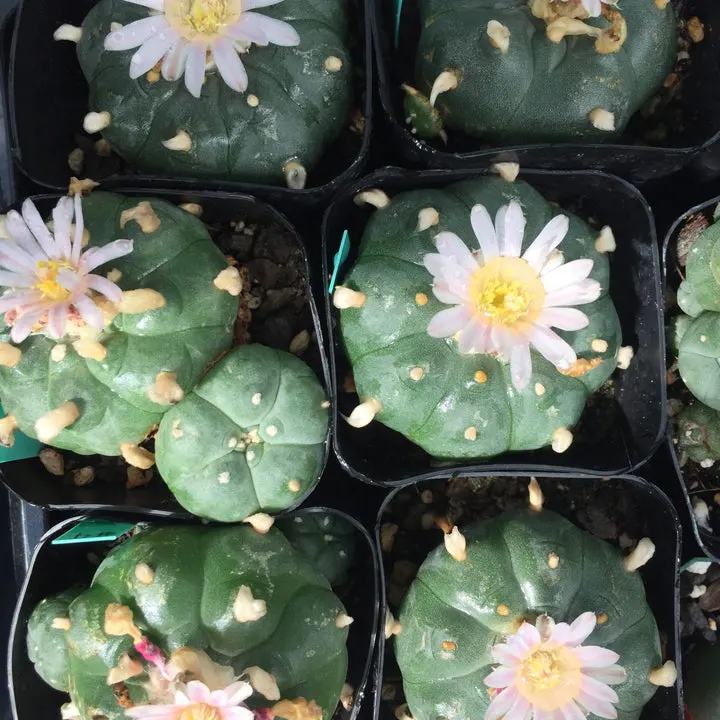
Variegate forms: Variegate Lophophora williamsii var. caespitosa are seldom available, but coveted by impassioned for the beautiful spineless body stripped in yellow-cream or pink. The odd variegate appear unpredictably in seedling batches in a small percentage, and are generally separated from normal plants. Variegated plants grow more slowly, and are generally smaller than non-variegates. Coloured areas are also generally weaker, and more susceptible to fungus, sunburn and other defects. A large well grown variegate Lophophora is truly an achievement. These are harder to grow well than they appear.More…
Subspecies, varieties, forms and cultivars of plants belonging to the Lophophora williamsii groupLophophora fricii var. decipiens (Croizat) P.Hansen: With the exception of the smaller and more pale pink flowers, its appearance corresponds to the appearance of Lophophora Fricii.
Lophophora williamsii (Lem. ex Salm-Dyck) J.M.Coult.: Globular or somewhat flattened glaucous green or greyish green spineless cactus up to 6 cm tall, 12 cm diameter, with a woolly top; It has a large taproot which may extend over 25 cm below ground level.
Lophophora williamsii var. caespitosa Y.Itô: This name is used to indicate a number of clones of horticultural origin characterized by a more or less accentuated production of axillary shoots that in age grow and form huge cushions.
Lophophora williamsii var. caespitosa f. variegata hort.: variegated form.
Lophophora williamsii var. cristata Houghton: There is an impressive array of cristates which forms glaucous green, dull bluish or greyish green, very succulent contorted and convoluted brain-like mounds. They are some of the more striking and priced crested cacti.
Lophophora williamsii var. echinata (Croizat) Bravo
Lophophora williamsii var. fricii (Haberm.) Grym: Beautiful variety with large intensive pink pink flowers.
Lophophora williamsii var. fricii f. cristata hort.: crested form.
Lophophora williamsii var. fricii f. variegata hort.
Lophophora williamsii var. fricii cv. Marbles: has wide and well developed rounded tubercles. Seems to be a pretty variable plant with several clones.
Lophophora williamsii subs. grymi Halda, J.Kupčák & Sladk.: Solitary or in group with 6-10 prominent straight ribs with low polygonal tubercles with short brownish wool. Flowers large pinkish-white.
Lophophora williamsii var. jourdaniana (Haberm.) hort.: It has rose-violet or dark pink-red perianth, pistil and filaments with small long persisting spines on young areoles. Old plant forms a dense cluster or mound.
Lophophora williamsii var. lewinii (Henn. ex Lewin) J.M.Coult.: Long areolar hairs.
Lophophora williamsii var. pentagona Croizat: All heads 5-ribbed.
Lophophora williamsii var. pluricostata Croizat: Ribs always numerous.
Lophophora williamsii var. texana Frič ex Kreuz.: (or texensis ) is the phenotype from the Texas area (USA), this local form has very grey pruinose stems with numerous flat ribs (up to 14 in adult specimens).
Lophophora williamsii cv. Kikko: This odd cultivar is easily distinguishable for its ± wide and long pointed tubercles along the bumped ribs edges. Seems to be a pretty variable plant with several clones.
More…
Cultivation and Propagation: Variegated and albinos Lophophora are regarded as choice and difficult in cultivation, but despite that some of them are relatively easy to grow. But be aware that they cannot tolerate prolonged exposure to direct sun light (especially during the hottest summer days), so grow them in half-shade or under filtered sun. They are sometime seen as grafted plants, but some grow well on their own roots, too.
On the contrary, the albinos can survive only if grafted on a strong green base. - *****Please be aware of your country’s custom,it is your risk.*******
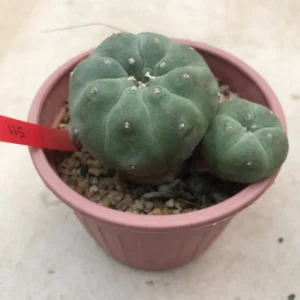
1.Plant size please see in the picture,it was showed with ruler.
2.Can request Phytosanitary Certificate and Cites document charge fee 20 usd.
3.If order over 200 usd will provide free Phytosanitary Certificate and Cites document.
If your order still are held by custom,We will send the replacement to you,
but if you dont want the replacement,We will refund 40% (it is fair for seller and buyer together),
We will not refund for rotten plant or We do not accept return option.
All plants are healthy and strong, and will be securely packed and shipped in a hard box, they are sent bare root and clean of most soil . We will make every effort to ensure that the plants will arrive in good condition * while we ship we cannot garantee that they will not be damaged from
strike againt,termperatures and period of time.( Customer risk )
Plant size :please see in the picture,it was showed with ruler.
****** We are professional for the cactus and succulent.
All of product are real things and very good.
Shipping
We ship by very safety and ship in Bare root only.
We Ship by registered airmail and add tracking number for buyer
For register by airmail 15 usd ship within 15-21 business days after you make payment.
For EMS(Express mail) 55 usd will ship within7-10 days depend on process issue phyto and cites document.Satisfaction guarantee : if you Receive the product and you see that the cactus is dead (dead only),
Please send a photo to me and contact us for a refund
Please be aware of your country’s custom.It’s your risk.
Thank You So much
Related products
-
Cactus
Ayahuasca
Price range: £80.00 through £350.00 Select options This product has multiple variants. The options may be chosen on the product page


Reviews
There are no reviews yet.